
Mauritius, Hak Ip, and Sweetheart TM Lychee Tree
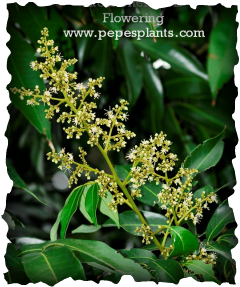
The finest for consistent production are the Mauritius and Brewster
Hak Ip varieties. These are excellent trees for backyard growers as well as commercial growers. Lychee trees grow best in sandy slightly acidic soils. Adding organic matter to sandy soils is extremely important for best growth and fruit production. Plant your tree in an area that offers wind protection and full sun. Young trees should be protected by using a wind screen around them. A newly planted tree will also require regular watering for at least the first two years of establishment.
Lychee trees require a cool dry winter and a wet hot summer for best fruit production. Trees bear fruit from May to July. Mauritius is the leading commercial cultivar in Florida. Lychee trees should be heavily mulched and grow very well using organic methods. Lychee trees are propagated by air layering because seeds will take as long as 8 to 10 years to produce fruit. Seed grown trees will not be identical to the fruiting tree. The one advantage a seedling has is the stronger root system. Today grafting Lychee trees is rare and generally not practical or necessary.
Pepe's Tip:
Keep Your Tree About 8 Foot Tall. Life will be easier for you and growing your tree will be a pleasure. Prune your tree immediately after you harvest that sweet delicious fruit. Spraying, picking and inspecting your tree will be easier and storm damage will be less severe in most cases. When pruning leave the lower branches in place so they shade out weeds. Keep the soil free of grass around the base of your lychee tree. Grass steals nutrients from the roots of your lychee tree and slows it's development.
One very important thing to remember is that shade on any part of your tree will slow down the growth. More sun equals more growth and more fruit per branch!
NOTE: Do not tip prune branches after Aug. Tip pruning stimulates new vegetative growth and reduces flowering in the spring.
 |
|
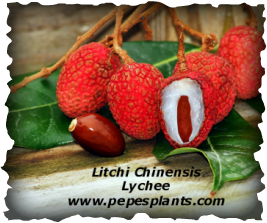
Warning: Eating Lychees can cause a serious addiction to them. Trust me if you like them you will get addicted. So are you ready to buy a lychee tree yet?
FAQ
How do I know my lychee is ripe and ready to eat?
Answer: Ripeness in lychees is determined by looking at the fruits skin and color. Flat bumps indicate the fruits have swollen with juice and fructose but not always a real indicator of sweetness. The dark red to purple color also is a good indicator of mature ready to eat fruit. Mouth watering!
When Should I prune my Lychee Tree?
Answer: Prune in July after you have harvested your fruit.
Should I plant more than one Lychee Tree?
Answer: Now that sounds like a good idea! How about mixing it up a bit. We suggest you plant at least two trees. Some good choices are Sweetheart/Hak Ip, Mauritius and even a Brewster. Having more trees makes cross pollination possible which offers higher yields. One other plus is that if one is having an off year the other will most likely be fruiting. Click here to visit our online store: They go fast!
Is mulching a lychee a good idea?
Answer: Yes, mulch your tree with organic material like composted shredded palm leaves, dry hay and kitchen greens, banana peels etc.
Can I grow lychee trees organically?
Answer: Of course! Growing them organically is the best way.
Can I grow my Lychee tree in the shade?
Answer: For best fruiting and tree health you should provide full sun.
Three Popular Lychee Fruits
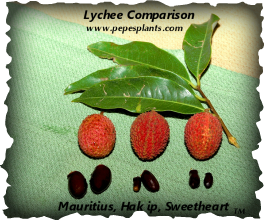
These lychees are all very good tasting. In my opinion the Hak ip and the Sweetheart TM are both super sweet and oh so incredibly similar. They are practically twins.
Many people believe they are actually the same. Well they are not the same. The Hak ip fruit is generally much darker than sweetheart. Hak ip means black leaf in Chinese. This is a good name since the leaves are a deep dark green.
People often wonder what is the common variety name for Sweetheart TM. Well it is a bit of a mystery. The story is that Sweetheart TM was an import from Australia to Florida that lost it's original cultivar label. This unlabeled Lychee was named and trademarked Sweetheart TM. It's easy to notice the seeds on Hak ip and Sweetheart TM. They are really tiny. They vary a bit from fruit to fruit but usually quite small compared to other lychees.
One other difference I always seem to find is that Sweetheart TM has the smallest seeds compared to any other Lychee I have eaten so far.
Mauritius is also very good and the flavor a little bit spicy (sort of like cinnamon) but sweet. The seed is larger and the fruit a bit smaller and not as colorful.
|
|



Your one stop site for all of your mango research and social resources.
|


* FDA Disclaimer
The products and statements made about specific plants or products on this web site have not been evaluated by the United States Food and Drug Administration (FDA) and are not intended to diagnose, treat, cure or prevent disease. All information provided on this web site or any information contained on or in any product label or packaging is for informational purposes only and is not intended as a substitute for advice from your physician or other health care professional. You should not use the information on this web site for diagnosis or treatment of any health problem. Always consult with a healthcare professional before starting any new vitamins, supplements, diet, or exercise program, before taking any medication, or if you have or suspect you might have a health problem.
Advertising Disclosure:
Pepesplants.com is a participant in the Amazon Services LLC Associates Program and also Googles affiliate advertising program. The programs provide a means for web sites to earn revenues from advertising and or sales.
Content Disclosure
Use all information on this site at your own risk.
The content here is based on the publishers personal experience in the green industries.
Although every reasonable effort has been made to ensure the accuracy of the information contained on this site, absolute accuracy cannot be guaranteed. This site, and all information and materials appearing on it, are presented to the user "as is" without warranty of any kind, either express or implied
The products and statements made about specific plants or products on this web site have not been evaluated by the United States Food and Drug Administration (FDA) and are not intended to diagnose, treat, cure or prevent disease. All information provided on this web site or any information contained on or in any product label or packaging is for informational purposes only and is not intended as a substitute for advice from your physician or other health care professional. You should not use the information on this web site for diagnosis or treatment of any health problem. Always consult with a healthcare professional before starting any new vitamins, supplements, diet, or exercise program, before taking any medication, or if you have or suspect you might have a health problem.
Advertising Disclosure:
Pepesplants.com is a participant in the Amazon Services LLC Associates Program and also Googles affiliate advertising program. The programs provide a means for web sites to earn revenues from advertising and or sales.
Content Disclosure
Use all information on this site at your own risk.
The content here is based on the publishers personal experience in the green industries.
Although every reasonable effort has been made to ensure the accuracy of the information contained on this site, absolute accuracy cannot be guaranteed. This site, and all information and materials appearing on it, are presented to the user "as is" without warranty of any kind, either express or implied
Site created and managed by Pepe's Fruit Trees. Copyright 2024 - All Right Reserved
Site created and managed by Pepe's Fruit Trees. Copyright 2024 - All Right Reserved