
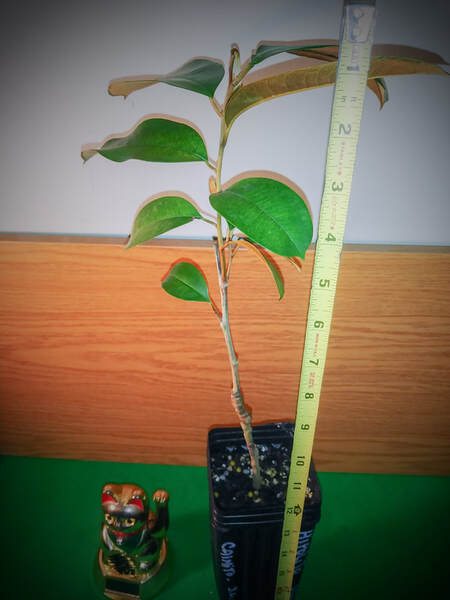
Caimito Tree
Caimito Star Apple Chrysophyllum cainito
Caimitos are widely distributed throughout Central America and the Caribbean. The trees also grow well here in South Florida and were introduced in the 1900's. They do not like cold snaps and young trees are easily killed at temperatures in the low 30's. Always plant your tree in full sun for best growth and fruit production.
Temperatures in the low 40's accompanied by wind cause wind chill and this will often defoliate trees. Mature trees, however, have survived temperatures as low as 29 degrees.
We recommend you grow your tree in a container until it reaches a height of about 8 feet before planting. This makes it easier to protect the tree while it matures. As with all tropical trees planted in the landscape, be sure to wrap the tree trunk with blankets if low temperatures threaten and consider hanging some incandescent bulbs to keep the tree warm on those rare brutal South Florida winters.
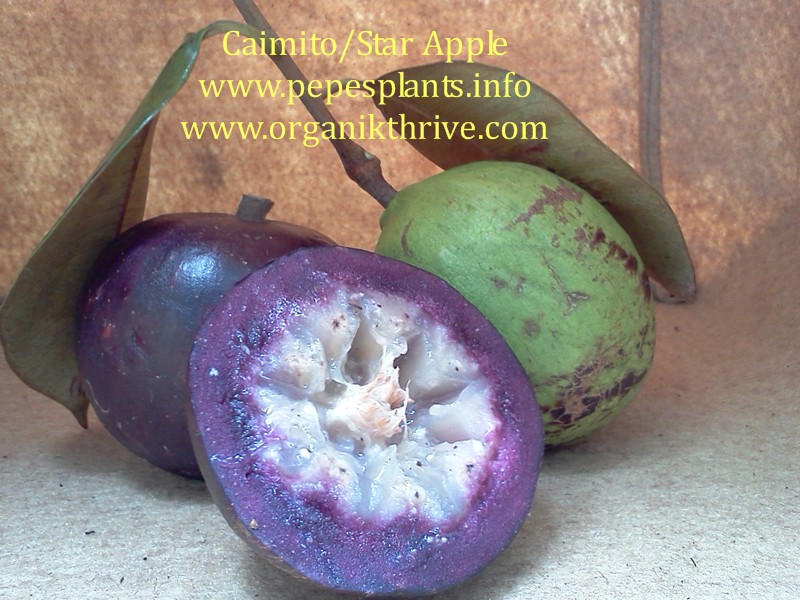
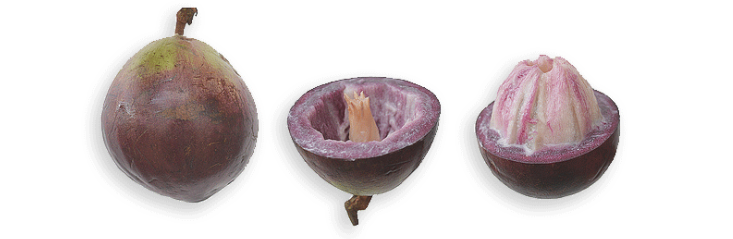
Caimito trees require a well drained soil and they grow well in a variety of soil types. Trees are very attractive with rich green and golden colored leaves. Leaves are golden underneath and green on the top. The trees produce round or pear shaped purple or green skinned fruit. Purple skinned fruit are red to purple fleshed. Green skinned Caimito fruit is white fleshed inside. Caimito fruits are sweet and delicious. When the fruits are cut in half they resemble a star.
Caimitos are in season from late winter or early spring to early summer. They do not fall when ripe but must be hand-picked by clipping the stem. Be sure the fruit is ripe before harvesting. Unripe fruits will be gummy and inedible. A fully ripe Caimito fruit will have dull skin and slightly wrinkled. The fruit will be a little soft to the touch.
Okay are you ready to eat? Wait don't bite into that fruit! Be sure to slice the fruit in half and eat the inside. When you slice into the fruit do not allow any of the bitter latex of the skin to contact the edible flesh. Remember,the skin, seeds and rind are not edible. Caimitos are best eaten chilled. They are delicious all by themselves and you can enjoy a special treat when you prepare a fruit cocktail by adding mango and pineapple. Oh my! YUMMY!!
Tip:
Some nurseries grow many fruit trees under shade cloth. This is a common practice in the trade. Be sure to ask and if so, slowly acclimate the tree to more and more light before planting. This will avoid the possibility that the trees leaves will sunburn. Sun burnt leaves won't kill the tree but your tree may not look to good for a while. Be sure to water lightly if major leaf loss occurs.
Okay are you ready to eat? Wait don't bite into that fruit! Be sure to slice the fruit in half and eat the inside. When you slice into the fruit do not allow any of the bitter latex of the skin to contact the edible flesh. Remember,the skin, seeds and rind are not edible. Caimitos are best eaten chilled. They are delicious all by themselves and you can enjoy a special treat when you prepare a fruit cocktail by adding mango and pineapple. Oh my! YUMMY!!
Tip:
Some nurseries grow many fruit trees under shade cloth. This is a common practice in the trade. Be sure to ask and if so, slowly acclimate the tree to more and more light before planting. This will avoid the possibility that the trees leaves will sunburn. Sun burnt leaves won't kill the tree but your tree may not look to good for a while. Be sure to water lightly if major leaf loss occurs.
General Fertilizer Recommendations for Caimito
Trees in the landscape.
Caimito trees in the landscape are fertilized
with 8-3-9-3 or similar.
Young trees: 1/4 lb every 2 months
Mature trees: 1-2 lbs is applied 4 times per year.
Maximum of 15-20 lbs per year.
Do not fertilize in winter!
Trees in the landscape.
Caimito trees in the landscape are fertilized
with 8-3-9-3 or similar.
Young trees: 1/4 lb every 2 months
Mature trees: 1-2 lbs is applied 4 times per year.
Maximum of 15-20 lbs per year.
Do not fertilize in winter!
Medicinal Uses of Caimito
The ripe fruit, because of its mucilaginous character, is eaten to sooth inflammation in laryngitis and pneumonia. It is given as a treatment for diabetes mellitus, and as a decoction is gargled to relieve angina. In Venezuela, the slightly unripe fruits are eaten to overcome intestinal disturbances. In excess, they cause constipation. A decoction of the rind, or of the leaves, is taken as a pectoral. A decoction of the tannin-rich, astringent bark is drunk as a tonic and stimulant, and is taken to halt diarrhea, dysentery and hemorrhages, and as a treatment for gonorrhea and "catarrh of the bladder". The bitter, pulverized seed is taken as a tonic, diuretic and febrifuge. Cuban residents in Miami are known to seek the leaves in order to administer the decoction as a cancer remedy. Many high-tannin plant materials are believed by Latin Americans to be carcinostatic. In Brazil, the latex of the tree is applied on abscesses and, when dried and powdered, is given as a potent vermifuge. Else where, it is taken as a diuretic, febrifuge and remedy for dysentery.
Morton, J. 1987. Star Apple. p. 408–410. In: Fruits of warm climates. Julia F. Morton, Miami, FL.
Morton, J. 1987. Star Apple. p. 408–410. In: Fruits of warm climates. Julia F. Morton, Miami, FL.
|
|



Your one stop site for all of your mango research and social resources.
|


* FDA Disclaimer
The products and statements made about specific plants or products on this web site have not been evaluated by the United States Food and Drug Administration (FDA) and are not intended to diagnose, treat, cure or prevent disease. All information provided on this web site or any information contained on or in any product label or packaging is for informational purposes only and is not intended as a substitute for advice from your physician or other health care professional. You should not use the information on this web site for diagnosis or treatment of any health problem. Always consult with a healthcare professional before starting any new vitamins, supplements, diet, or exercise program, before taking any medication, or if you have or suspect you might have a health problem.
Advertising Disclosure:
Pepesplants.com is a participant in the Amazon Services LLC Associates Program and also Googles affiliate advertising program. The programs provide a means for web sites to earn revenues from advertising and or sales.
Content Disclosure
Use all information on this site at your own risk.
The content here is based on the publishers personal experience in the green industries.
Although every reasonable effort has been made to ensure the accuracy of the information contained on this site, absolute accuracy cannot be guaranteed. This site, and all information and materials appearing on it, are presented to the user "as is" without warranty of any kind, either express or implied
The products and statements made about specific plants or products on this web site have not been evaluated by the United States Food and Drug Administration (FDA) and are not intended to diagnose, treat, cure or prevent disease. All information provided on this web site or any information contained on or in any product label or packaging is for informational purposes only and is not intended as a substitute for advice from your physician or other health care professional. You should not use the information on this web site for diagnosis or treatment of any health problem. Always consult with a healthcare professional before starting any new vitamins, supplements, diet, or exercise program, before taking any medication, or if you have or suspect you might have a health problem.
Advertising Disclosure:
Pepesplants.com is a participant in the Amazon Services LLC Associates Program and also Googles affiliate advertising program. The programs provide a means for web sites to earn revenues from advertising and or sales.
Content Disclosure
Use all information on this site at your own risk.
The content here is based on the publishers personal experience in the green industries.
Although every reasonable effort has been made to ensure the accuracy of the information contained on this site, absolute accuracy cannot be guaranteed. This site, and all information and materials appearing on it, are presented to the user "as is" without warranty of any kind, either express or implied
Site created and managed by Pepe's Fruit Trees. Copyright 2024 - All Right Reserved
Site created and managed by Pepe's Fruit Trees. Copyright 2024 - All Right Reserved