FLORIDA FRUIT TREES FOR FLORIDA CUSTOMERS - FREE STATE WIDE SHIPPING
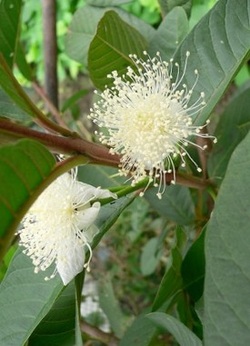
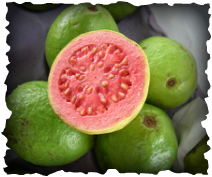
Guava Psidium guajava L
Guava trees have been around for hundreds and hundreds of years. The Guava has been known to exist as far back as the mid 1500's. The trees are believed to have originated from Central America. Guava trees are common in all of the tropics today and trees do well in most sub tropical regions. Trees are found growing worldwide in warm regions.
Guavas are considered native trees here in Florida and also a nuisance plant and often people are advised not to plant them. To me this is just plain crazy. I say plant all you can. It is food and that's good for us and our wildlife as well.
Wildlife actually is the main reason that Guava can become an invasive species. Be sure to plant only the best varieties so that the wildlife can spread out the best of the best! Well all kidding aside here, avoid seed grown varieties and stick to improved cultivars either air layered or from cuttings. Remember a seed may or may not be so great and the time it takes to produce fruit can be several years. On the other hand, cuttings and air layers are producing so quickly they can make your head spin and your mouth water!
Guava trees were introduced to South Florida in the mid 1800's. By the late 1880's Guava plantations stretched across almost half the entire southern regions of Florida. Trees also stretched across the West indies, The Bahamas, Jamaica, Cuba and all of the caribbean. Trees can been found in South America, Africa, Australia, Guam, the Pacific Islands and also in Asia. The middle east also provides excellent growing areas.
Florida began commercial production in several areas of the State back in the early 1900's. Opa Locka and Punta Gorda were just two important pioneer areas for commercial Guava groves. By 1946 with World War II in full swing, commercial Guava production in Florida grew tremendously.
Did you know that you could grow as much as 600 bushels of Guava per acre of land. Guava trees can be grown organically and actually do much better than trees given synthetic fertilizers. To some, the fact they grow better organically comes as quite a shock. It's amazing how well they respond to steady organic mulching and applications of composted manures.
Guava trees can become crowded so space them about ten feet apart and keep them around ten foot tall or smaller if planting a commercial grove. For backyard growing just keep your trees around six feet tall and bushy. Guava pests are usually temporary and can be controlled by the use of neem oil and some other organic pesticides. Proper pruning and grove cleanliness is important to prevent and control diseases and pests. Pick up all fallen fruit and prune all dead damaged wood. The guava will not withstand a frost unless in a micro-climate. Guava trees are more flood tolerant than most other Sub Tropical Fruit Trees.
Guava
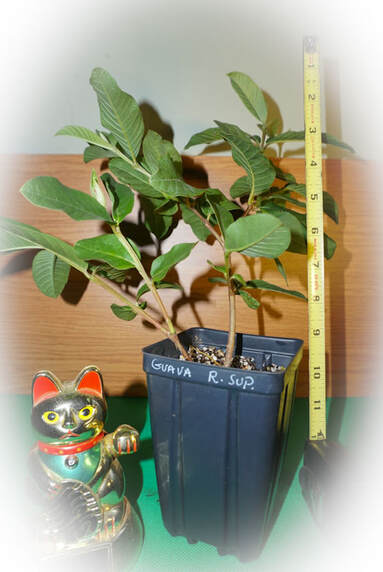
Ruby Supreme is an excellent hybrid for South Florida. Very tasty and resistant to insects and diseases. Excellent fruit yields in summer months. Small, roundish fruit. Skin greenish-yellow. Flesh dark pinkish-orange. Tree bushy, low growing, with vigorous branches drooping outward.
Tip: If your Guava tree is at least one year old and it has not flowered you should prune the tree! Pruning stimulates flower production and of course produces fruit! It's a good idea to prune any suckers that emerge from the base of the tree.
Para Guava (Psidium acutangulum) a.k.a. Araca-pera
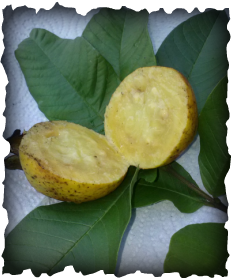
We recently obtained some seeds from a few of these guavas. The fruit is a medium sized yellow fruit with very tasty yellow pulp similar to the guava but has a much more acidic flavor. A friend from Colombia swears it makes an amazingly refreshing and tasty beverage. Prepare like lemonade using honey for a real treat. Very excellent source of antioxidants.
I had a glass of the beverage and it was superb!
It is known as Coronilla in Colombia and other Areas of South America. This tree is grown as a small shrub or as a medium standard tree. Coronilla is not as cold tolerant as its relative Psidium guajava L
These trees are best grown in a tropical climate but I have seen many around South Florida. They require a high annual rainfall and grow well in either full sun or part shade.
Trees are propagated by seedbut we will eventually select superior varieties and produce from air layering.
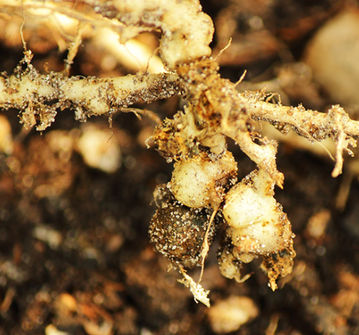
NOTE: Nematodes, more specifically the root-knot nematodes (Meloidogyne spp.), are a major threat to many plants. Most gardeners consider them a problem solely confronted in the vegetable patch. The reality is that they affect many fruit trees like Fig, Peach and guava among others. Nematodes are tiny microscope pests. Nematodes can be of many species. Some species can be beneficial while others are non beneficial residents in your soil. The real trouble makers are generally found in sandy nutrient poor soil.
Some of these bad creatures can destroy the root system of plants and therefore, inhibit the effectiveness of nutrients and water uptake, resulting in poor yields. In severe infestations, plants can be killed by the nematodes.
You can cover the soil in an area suspected of nematodes with clear plastic. Leave the plastic in place for several months to solarize the soil and kill the nematodes. Cover an area at least twice the width of the planting diameter.
When growing in containers it is a good idea to check your roots a few times a year for nematode damage. Place your container at least 18 - 20 inches above the soil on a concrete or wooden platform. It really helps! You can also change the soil once a year and solarize the old soil in the old container by covering it with plastic for two months. Solarize the soil not the container with the plant. Oh my! :-|
When the soil has been solarized, you can incorporate heavy mulching on the surface and use organic fertilizers mixed into the soil. Consider adding mycorrhizae fungi around the trees roots to build healthy soil. This is a good way to control and prevent nematodes.
Chemical measures are available to control these organisms, but they are expensive methods and highly toxic!